It is a covered larch-wood bridge, 58 metres long and 7.82 wide, carried by four timber piers driven into the bed of the Brenta. It has been in continuous use — pedestrian and commercial — for eight centuries, and yet it is, in essence, the very same work of 1569.
What you cross today is the bridge rebuilt in 1948. What people crossed before 1945 was the bridge rebuilt in 1821 after the flood of 1813. The 1821 one was itself a copy of Ferracina's bridge of 1748, which had replaced Palladio's, destroyed in 1748. And yet it is always, stubbornly, the same bridge: five spans, a double-pitched roof, trestle piers angled to reduce the thrust of the water. The 1569 design has never been surpassed. Every generation has recognised it as the right way — the only way — to cross the Brenta at Bassano.
This fidelity to the original design makes the Bassano bridge an almost unique case in Italy's architectural heritage: not a monument to be preserved by freezing it, but a living artefact — maintained, rebuilt, reworked — and preserved precisely for that reason.
Andrea della Gondola, known as Palladio (1508–1580), is fifty-one when the council of Bassano commissions him to design the new bridge. He has just finished Villa Capra and is working on the civic basilicas of Vicenza and Udine. He is, to all intents, the most important architect of the Republic of Venice.
The previous bridge, of 1567, has just been destroyed by a flood of the Brenta. The town would like a stone structure, like other cities. Palladio proposes the opposite: the bridge must stay wooden. The reason is technical, not aesthetic.
"The Brenta — he writes in the Four Books of Architecture — is a river that carries very large and numerous timbers, and rushes down from the Alps with great force. Stone piers could not be set in it without being swept away. It shall therefore be made entirely of timber." — Andrea Palladio, The Four Books of Architecture, Book III, ch. VIII
The logic is that of a hydraulic engineer, not a classicist. Stone piers would be scoured away by floods; timber piers, light and with angled feet, work elastically. When the water rises and the logs it carries strike the structure, the bridge vibrates but does not yield. On the Brenta, Palladio invents a solution that engineering treatises still call the bridge alla bassanese.
Palladio's three innovations:
First documentary mention of a timber bridge over the Brenta at Bassano, in an act of the podestà Gerardo Maurisio. A modest work, perhaps a single span, slightly further upstream.
Four rebuildings due to floods, fires and — in 1525 — an incursion of imperial troops. Bassano lies on the strategic Brenner road.
A flood of the Brenta carries the bridge away completely. Reconstruction is decided and Palladio is called.
Construction of the new bridge to Palladio's design. The first time the angled trestle piers are used on a monumental scale.
The great flood of winter 1748 brings down the Palladian bridge. Bartolomeo Ferracina, a self-taught engineer from Solagna, rebuilds it exactly identical — copy for copy.
A new flood overwhelms it. The bridge remains out of use for years under Austrian rule.
Angelo Casarotti rebuilds it under Austrian supervision. The design is unchanged.
To stop the German retreat, partisans of the "Cesare Battisti" battalion mine and blow up the bridge — the only deliberate destruction in its history.
The National Alpine Association funds the reconstruction with donations from all of Italy. On 3 October 1948 the bridge reopens. From that day it is the Alpini Bridge.
Full restoration funded by the Heritage Office and the Veneto Region. Beams and an entire pier replaced. The bridge reopens in November 2024, once again identical to itself.
The popular name by which the bridge is known today was born after the war. In 1945 Palladio's bridge no longer exists: the eastern abutment stands, the rest is a stretch of broken beams on the riverbed. Italy is in ruins and no public authority has the money to rebuild it.
The National Alpine Association (ANA) — the mountain corps whose symbolic home is Bassano — launches a nationwide subscription in 1947. Every ANA section in Italy pays its share. 14 million lire are raised. The bridge is rebuilt identical to Palladio's work and inaugurated on 3 October 1948.
From that day the bridge belongs to the National Alpine Association, formally its owner and responsible for its upkeep. A private property, a public work, a collective identity: the Bassano bridge is one of the few things in Italy that manages to be all three at once.
At the head of the bridge stands the Taverna al Ponte, still in service, where Alpini marching from all over Italy stop for a drink before their annual gathering. The song Sul ponte di Bassano, written around 1916 in the trenches of the Grappa, has been the corps' unofficial anthem ever since.
Sul ponte di Bassano
là ci darem la mano
là ci darem la mano
ed un bacin d'amor. — Sul ponte di Bassano, song of the Alpini
The reasons Palladio's design is still valid after four and a half centuries are three, and all three are lessons in good engineering worth re-reading today.
The piers are clusters of four larch poles, angled about 12° downstream. When the river rises, the current flows beneath the angled feet instead of hitting them head-on. When a log carried by the flood strikes the pier, the impact is absorbed by the whole system, which sways. It is an elastic structure, not a rigid one.
Larch — abundant in the valleys upstream of Bassano — is the ideal species: resinous, durable underwater (Venice's foundations are of Cadore larch), elastic yet strong. The double-pitched roof protects it from rain. The parts below the waterline, naturally impregnated, last over a century without chemical treatment.
This is the subtlest lesson. A stone structure that breaks is a permanent disaster. A timber structure that breaks is a six-month building site. The Bassano bridge is designed from the outset to be rebuilt: joints are accessible, beams are modules, piers are replaceable clusters. Its endurance through the centuries is not the durability of materials but the durability of a method.
It is a conception of architecture we would today call sustainable in the strong sense: not a work that claims to last forever, but a system that allows the artefact to be remade, always, with local resources and no special technology.
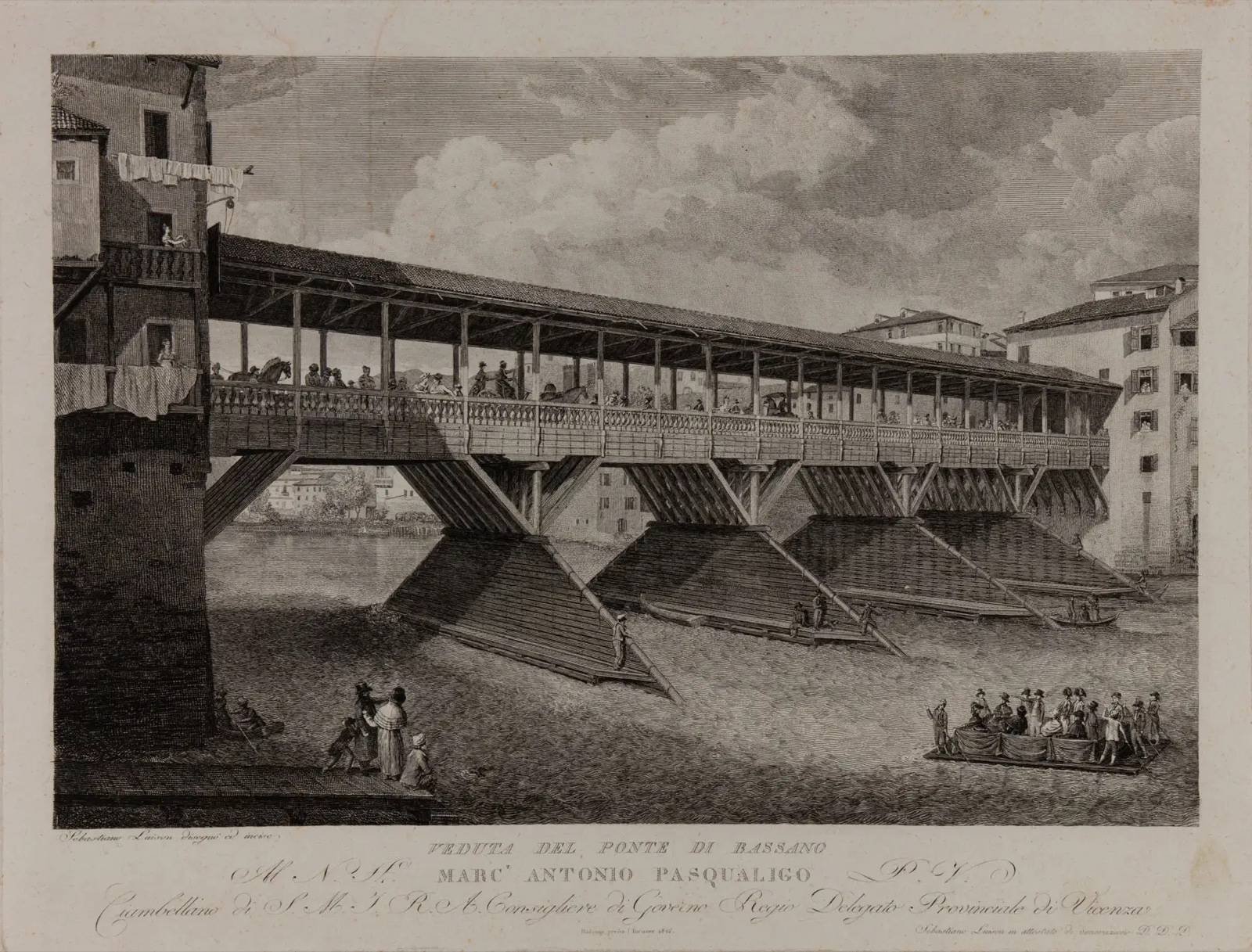
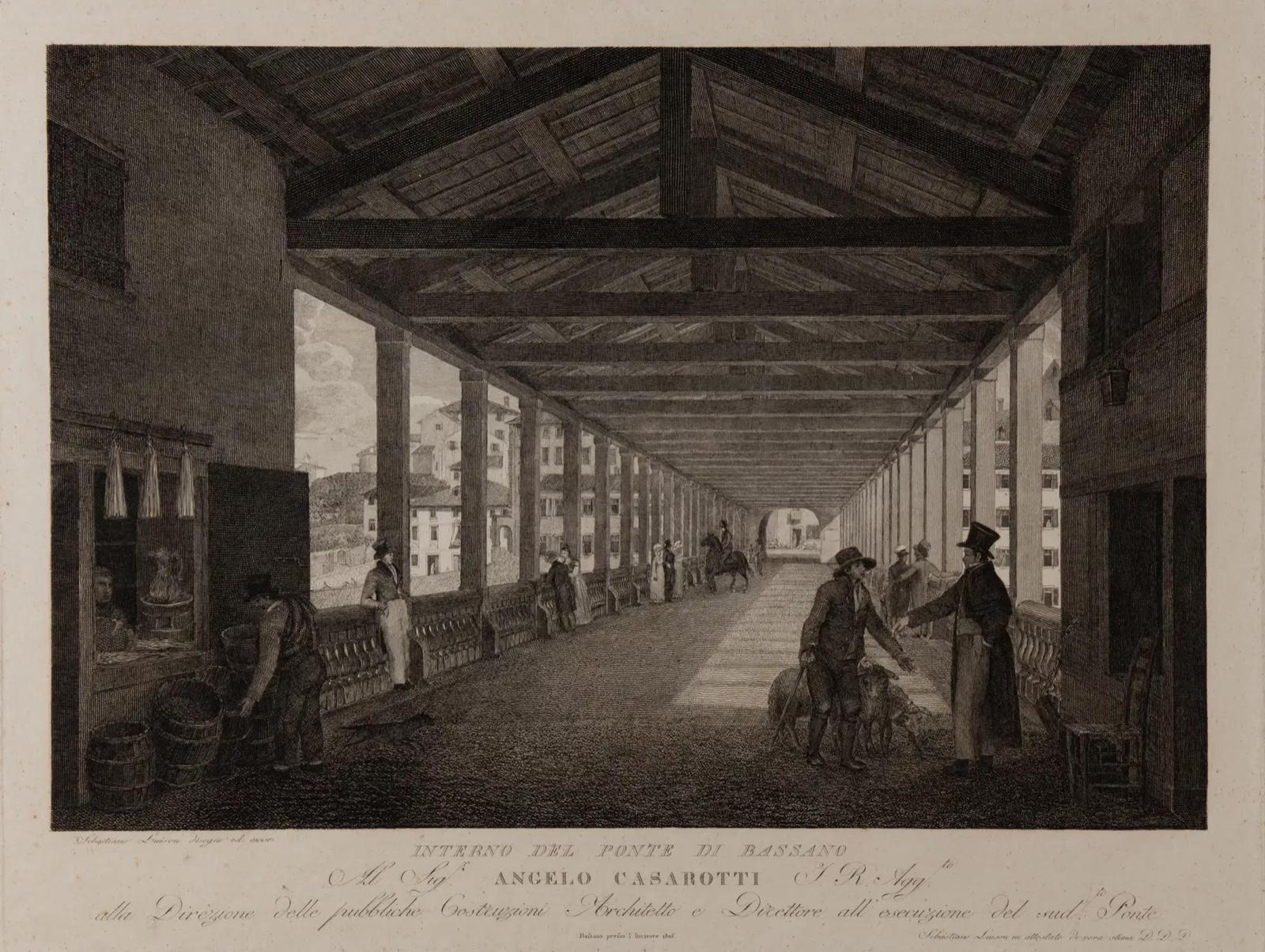
Two engravings by Sebastiano Luison, dated 1846, show the bridge as it was in the 19th century: the inner loggia thronged with merchants and travellers; the external view with the timber rafts arriving from Valstagna.